Test Systems
GtestWorks Automated Testing Platform
VectWorks 3.0 Electrical Performance Test Software






As the "vehicle energy nerve center," the vehicle DC-DC converter plays a critical role in the electric vehicle energy management system. Its core function is to convert the high-voltage DC power from the traction battery pack (typically 300-800V) into stable low-voltage DC power required by the system (e.g., 12V, 24V, or 48V), powering entertainment systems, lighting systems, power steering systems, air conditioning, and other auxiliary equipment, while ensuring the stable operation of the vehicle's low-voltage electrical system and control system.
During vehicle operation, the DC-DC converter must adapt to extreme conditions such as a wide temperature range of -40°C to 125°C, voltage surges like 100V/200V load dump, while also facing complex electrical conditions like overvoltage, undervoltage, short circuits, and electromagnetic interference. The stability requirements under such extreme environments make electrical performance testing a necessary means to verify its environmental adaptability and reliability.
The core value of electrical performance testing is reflected in the multiple guarantees it provides for vehicle safety, reliability, and compliance. In terms of safety, the stable operation of the DC-DC converter is directly related to the continuity of low-voltage system power supply. Abnormal parameters like output ripple can lead to BMS misoperation, input filter damage, and other component failures, thereby affecting the power safety of electric vehicles.
Products without rigorous testing have high early failure rates. Testing significantly reduces post-sales failure risks.
DC-DC products that comply with standards like ISO 16750 show significantly improved reliability.
Meet industry access standards and certification requirements.
ISO 16750-2:2023, as the core standard for environmental conditions and testing of road vehicle electrical and electronic equipment, underwent systematic updates compared to the 2012 version. The most notable change is the extension of the superimposed AC voltage test frequency range to 200kHz. The test is divided into reference test and formal test, using step injection method.
The reference test uses 2% logarithmic steps to determine the voltage ripple UR for each frequency point. The formal test injects according to the UR value determined in the reference test, with a dwell time ≥2s per frequency point.
f1 frequency band Upp=6V/3V/2V (12V system), 10V/3V/2V (24V system), Ipp=15A; f2 frequency band Upp=1V, Ipp=10A.
The core technical specification for vehicle DC-DC converters in China is represented by GB/T 24347-2021 "Electric Vehicles DC/DC Converters". This standard specifies requirements for input-output characteristic tests, protection function tests, environmental adaptability tests, electromagnetic compatibility tests, and electrical safety tests.
In no-output state of DC/DC, for ports with a fixed connection to the low-voltage battery (cannot be controlled to disconnect), the quiescent current shall not exceed 3mA.
The insulation resistance between each independent live circuit and ground (enclosure) shall be not less than 10MΩ, and the insulation resistance between circuits without electrical connection shall be not less than 10MΩ.
The VW80000 standard developed by the Volkswagen Group for vehicle electronic and electrical components imposes higher requirements based on international standards like ISO, primarily applicable to electrical and electronic components of cars under 3.5 tons.
Mercedes-Benz has established the MBN LV124-1 2013 standard for electrical performance testing of vehicle components to meet reliability needs under specific environments.
| No. | Test Item | VW80000:2021 | MBN LV124-1 2013 |
|---|---|---|---|
| E-03 | Transient Undervoltage |
9V-10.8V, 1V/ms Cycles: 10 DUT Quantity: No requirement Added E-03b test |
9V-10.8V, 1V/ms Cycles: 3 DUT Quantity: At least 6 |
| E-06 | Superimposed AC Voltage |
15Hz-200kHz/6Vpp Triangular/Logarithmic Sweep 15 cycles Ri≤100mΩ |
15Hz-30kHz/6Vpp Triangular/Logarithmic Sweep 15 cycles Ri≤100mΩ |
| E-17 | Signal Line and Load Circuit Short Circuit |
Vopmin, Vopmax 4 test cases |
UBmin, UBmax 3 test cases |
| E-21 | Reverse Feed |
0.2V-Vopmax Voltage at test terminal must drop below 1V within 20ms after switch-off 2 test cases |
0.2V-UBmax Voltage at test terminal must drop below 1V within 20ms after switch-off 1 test case, with added requirements for test terminals |
| E-23 | Balancing Current for Multi-Supply Voltages |
±32V Balancing current not to exceed 100uA |
None |
| E-24 | Switch Durability Test |
12V: Vopmin, Vop, Vopmax other: 48V, HVAC, HVDC |
None |
NIO's 900V high-voltage platform, as the core of its full-domain electric drive architecture, has a rated voltage of 925V, posing special requirements for DC-DC converters that are significantly different from traditional automaker standards, while also driving innovation in the testing system.
Electrical performance testing is a key link in evaluating the core performance of vehicle DC-DC converters, where efficiency and ripple characteristics are the core indicators measuring their performance, directly related to vehicle range and electronic equipment stability.
National standards require low-voltage output DC/DC efficiency to be ≥88%, E1 grade >92%. High-voltage output DC/DC efficiency needs to be ≥95%.
If ripple exceeds the standard, its high-frequency components can couple through the power chain to sensitive equipment like vehicle radar and autonomous driving sensors, interfering with analog signal acquisition and digital communication waveforms.
Transient and protection function testing are key to ensuring the reliable operation of vehicle DC-DC converters in complex automotive electrical environments.
Simulates voltage spikes under automotive load dump conditions, e.g., spike voltage can reach 100V in 12V systems and 200V in 24V systems under extreme conditions.
If rated current IN≤10A, then test current Itest=3IN; if rated current IN>10A, then test current Itest=2IN (at least greater than 30A, maximum value 150A)
Electrical performance testing of vehicle DC-DC converters is not only a core part of product quality assurance but also a key driver for automakers to gain advantages in technology iteration, cost control, and market competition.
Reduce full lifecycle costs through preventive testing, achieving "testing is profitability"
Promote the implementation of cutting-edge technologies like wide-bandgap devices and bidirectional energy flow
Restructure R&D systems with automation and datafication to enhance competitiveness
| Name | Description |
|---|---|
| PTS Series Electrical Performance Test System |
Includes the following modules: PTS Series Power System Load Dump Module (Optional) Micro Interruption Module (Optional) Switching Module (Optional) Load Module (Optional) Withstand Voltage Test Module (Optional) ...... |
| VectWorks Electrical Performance Test Software | Upper Computer Software |
Supports the following standards:
GreenTest PTS Series Electrical Performance Test System consists of PTS Series Power System, Load Dump Module (Optional), Micro Interruption Module (Optional), etc. It is a modular, high-precision professional test platform specifically designed for electrical performance testing of automotive components.

High Integration Design

Hardware-Software Integration

Multi-Standard Compatibility

Easy to Expand
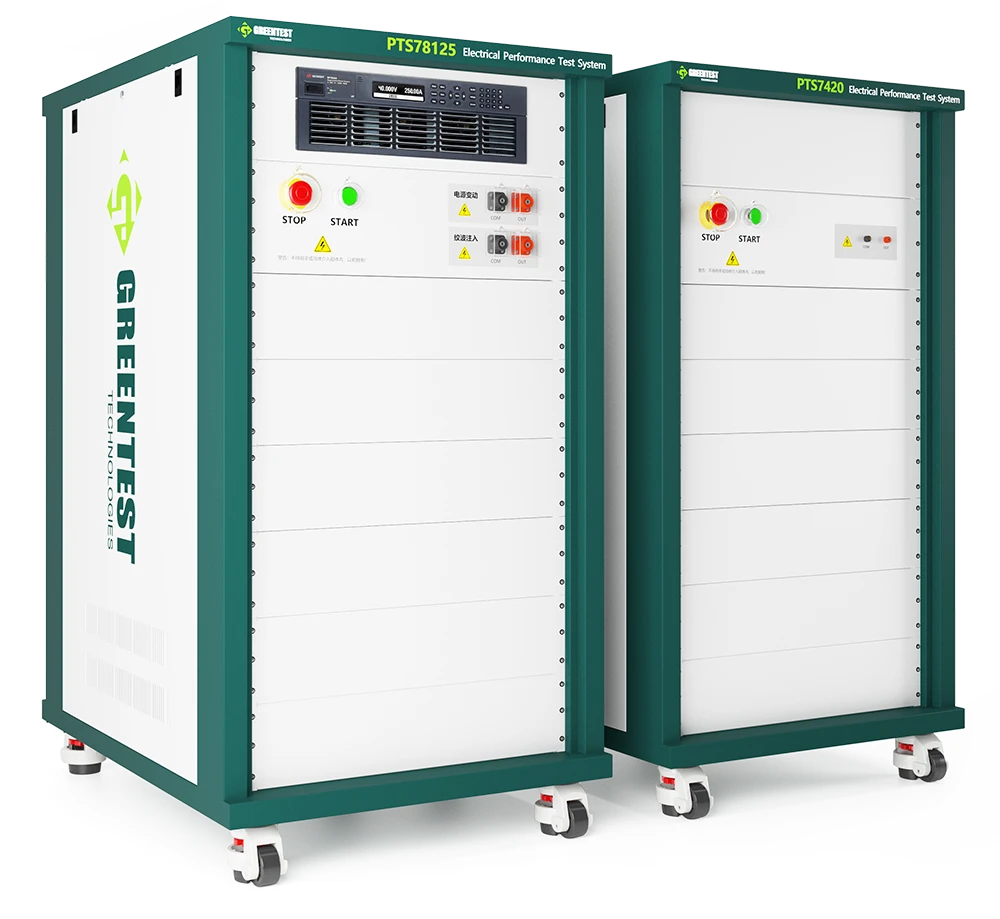
PTS Series Power System
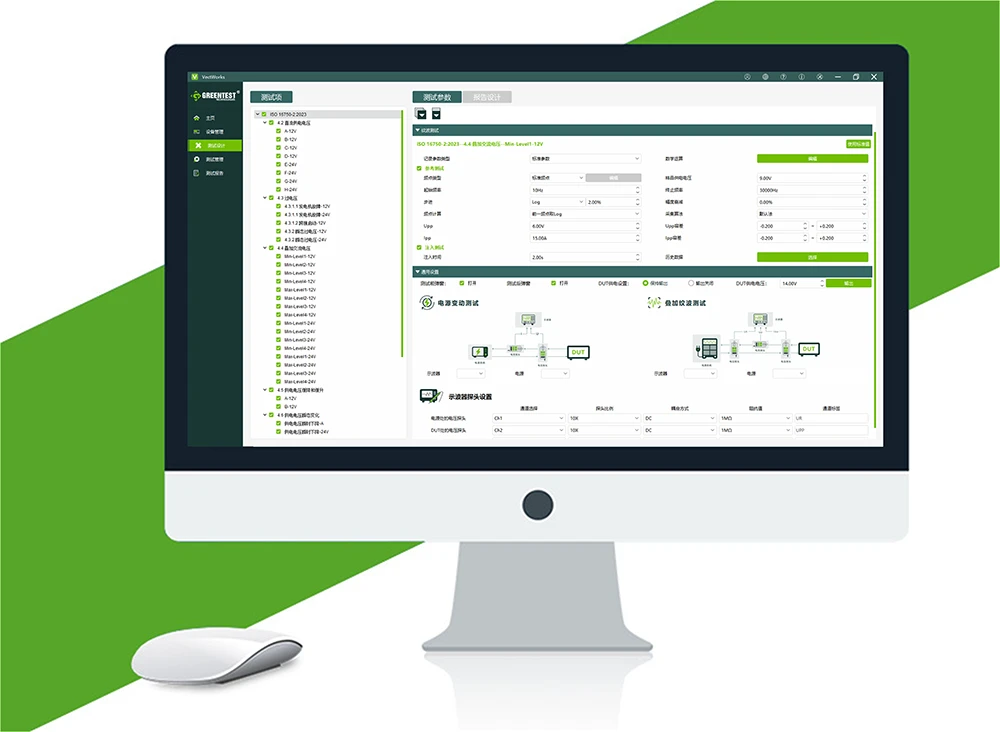
VectWorks Electrical Performance Test Software is a software developed by GreenTest based on the GtestWorks automated test platform. Its engine is based on dynamic test script execution. This foundational architecture facilitates easy and direct configuration of test sequences without requiring specific knowledge of how to remotely control instruments. Users only need to configure the test items and test levels, offering high flexibility.
The software provides users with standard-compliant test templates, enabling remote parameter setting, data acquisition, waveform editing, configuration import/export, report viewing, etc., achieving automation of complex tests.

Closed-Loop Dynamic Testing
Integrated real-time monitoring and dynamic feedback mechanism

High/Low Voltage Superimposed Ripple Test
Complies with standard verification requirements (including Upp, Ipp monitoring)

Power Supply and Amplifier Architecture
Compatible with bipolar power supply and amplifier architecture solutions
In vehicle DC-DC electrical performance testing, auxiliary test systems are key components to ensure the authenticity of the test environment and the accuracy of data, mainly including high/low temperature environmental simulation equipment and EMC test systems.
Must meet temperature range -70°C~150°C, temperature change rate ≥5°C/min. Some scenarios also require high/low temperature humidity test chambers to replicate complex climate conditions.
Must support conducted emission, radiated emission testing, and immunity testing.