





logo

Analysis of the Necessity of Vehicle ECU Electrical Performance Testing

Automotive Electronics
Electrical Performance Testing
Functional Safety

1. Introduction: The Core Value of Vehicle ECU Electrical Performance Testing

The Vehicle Electronic Control Unit (ECU), as the core control unit of the vehicle's electronic system, is metaphorically referred to as the "driving computer" or "vehicle brain." Its functions cover critical areas such as powertrain control (e.g., fuel injection, ignition timing), safety system management (e.g., Electronic Stability Control ESP, brake control), and coordination of the vehicle's overall status. With the continuous increase in vehicle electrification, the number of ECUs installed per vehicle has exceeded 80. Their reliability directly determines the vehicle's safety, power performance, and compliance.

ECU electrical performance defects can lead to serious safety hazards

Some Honda Imported Motorcycles

FI-ECU program defects may cause engine stalling and loss of driving force during operation

BMW

High-voltage battery ECU software issue leading to power interruption, involving recall of 70,000 electric vehicles

Volvo and Mack Trucks

ECU electrical noise interference or low power may cause communication failure, recalling 187,000 vehicles

Truck Manufacturer PACCAR

Electrical noise and power line carrier signal issues may cause the ECU to process commands incorrectly or stop working, recalling 220,972 trucks

Industry statistics further highlight the urgency of testing: currently, over 60% of vehicle faults originate from electronic system issues, with ECU failures accounting for a significant portion.


2. Domestic and International Electrical Performance Testing Standards System

Internationally Common Standards

Among internationally common standards, ISO 16750-2:2023 serves as the core standard for electrical load testing of vehicle electrical and electronic equipment. Compared to older versions (such as ISO 16750-2:2012), there are significant differences in test severity and technical adaptability.

Key Test Parameter Changes

The frequency range for superimposed AC voltage testing has been expanded from 50Hz-25kHz to 10Hz-200kHz. The test method changed from sweep frequency to single frequency point injection, and the test limits are divided more detailedly.

Standard Number ISO 16750-2:2012 ISO 16750-2:2023
Test Item 4.4 Superimposed AC Voltage 4.4 Superimposed AC Voltage
Frequency Range 50Hz-25kHz

f1=10Hz-30kHz

f2=30kHz-200kHz

Test Method Sweep mode, triangular, logarithmic Single frequency point injection, 2% logarithmic step, dwell time ≥ 2s
Test Limits Upp=1V/4V/10V(24V system)/2V(12V system)

f1: Upp=6V(12V system)/10V(24V system), Ipp=15A

f2: Upp=3V, Ipp=15A

f3: Upp=2V, Ipp=15A

f4: Upp=1V, Ipp=10A

Domestic Standards System

The domestic vehicle ECU electrical performance testing standards system is centered around the GB/T 28046 series. GB/T 28046.2 serves as the primary basis for electrical load testing, modified adoption of the international standard ISO 16750-2:2012, not equivalent adoption, and has not yet been updated to the ISO 16750:2023 version.

3. Mainstream Automaker Electrical Performance Testing Standard Requirements

German automakers are renowned for their stringent and technologically forward-looking standards in vehicle ECU electrical performance testing. Their standard requirements generally exceed international common standards, particularly forming significant differences in environmental adaptability, electromagnetic compatibility (EMC), and reliability testing dimensions.

Volkswagen (VW)

Centered on the VW 80000 standard, transient undervoltage testing covers short-term and long-term voltage dips. The standard also specifies requirements for balanced current testing of multi-power supply voltages and switching durability tests. Its superimposed AC voltage test uses sweep mode within the frequency range of 15Hz-200kHz.

Mercedes-Benz (Benz)

MBN LV124-1's superimposed AC voltage test covers 15Hz-30kHz, using sweep mode with a test limit of 6Vpp. The short-term interruption test is increased to 5 test sequences, and the standard specifies test points for dielectric strength testing.

4. Core Vehicle ECU Electrical Performance Test Items

Electrical Load Testing

Electrical load testing is one of the core items in vehicle ECU electrical performance testing. The commonly used test standard is GB/T 28046.2-2019 (adopting ISO 16750-2:2012).

Test Item Test Parameters
Supply Voltage Range 12V system typically Code C, 9V-16V; 24V system typically Code F, 16V-32V;
Overvoltage

Engine fault: Apply 18V (12V system)/36V (24V system) voltage at Tmax-20℃ and maintain for 60min;

Jump start test: Apply 24V voltage at room temperature and maintain for 60s;

Superimposed AC Voltage f=50Hz-25kHz, Upp=1V/4V/10V(24V system)/2V(12V system), sweep mode;
Supply Voltage Slow Decrease and Increase USmin decreases to 0V, then increases from 0V to USmin, linear rate of change 0.5V/min or step size not exceeding 25mV;
Supply Voltage Instantaneous Drop 12V system minimum instantaneous drop voltage is 4.5V, 24V system minimum instantaneous drop voltage is 9V, duration 100ms;
Reset Characteristics Decrease from USmin to 0.95USmin in 5% steps, hold for 5s, then increase to USmin, hold for 10s; decrease voltage to 0.9USmin, and so on;
Starting Characteristics 12V system: 4 test levels; 24V system: 3 test levels;
Load Dump

101V test pulse (12V system), 202V test pulse (24V system);

Reverse Voltage

Case 1 (12V system): Apply 4V to DUT effective input terminals for 60s (DUT used in unfused alternator circuits, and diodes can withstand reverse voltage for 60s);

Case 2: 12V system reverse voltage 14V, 24V system reverse voltage 28V;

Reference Ground and Supply Offset Offset voltage 1V;
Open Circuit

Single wire open: Disconnect one circuit of the DUT/system interface, then restore connection, open time 10s;

Multi-wire open: Disconnect the DUT's connection, then restore connection, open time 10s;

Short Circuit Protection

Signal circuits: All effective input and output terminals of the DUT are sequentially connected to USmax and ground, each for (60±6)s, other input and output terminals remain open;

Load circuits: Connect DUT to power supply, load circuit in working state, duration to be agreed;

Withstand Voltage

After damp heat cycle test, place DUT at room temperature for 0.5h, apply sinusoidal voltage 500V (RMS) (50Hz-60Hz) to DUT for 60s:

—— Between terminals with electrical insulation;
—— Between terminals with electrical insulation and housing with electrically conductive surface;
—— For plastic housing, between terminals and electrode wrapped around housing (e.g., metal foil);

Insulation Resistance

After damp heat cycle test, place DUT at room temperature for 0.5h, apply 500V DC voltage to DUT for 60s:

—— Between terminals with electrical insulation;
—— Between terminals with electrical insulation and housing with electrically conductive surface;
—— For plastic housing, between terminals and electrode wrapped around housing (e.g., metal foil);

5. Test System

Standard Support

  • ISO 16750-2:2023
  • VW 80000:2021
  • MBN LV124-1 2013
  • ISO 21780:2020
  • GB/T 45120-2024
  • MBN LV148 2013
  • ......

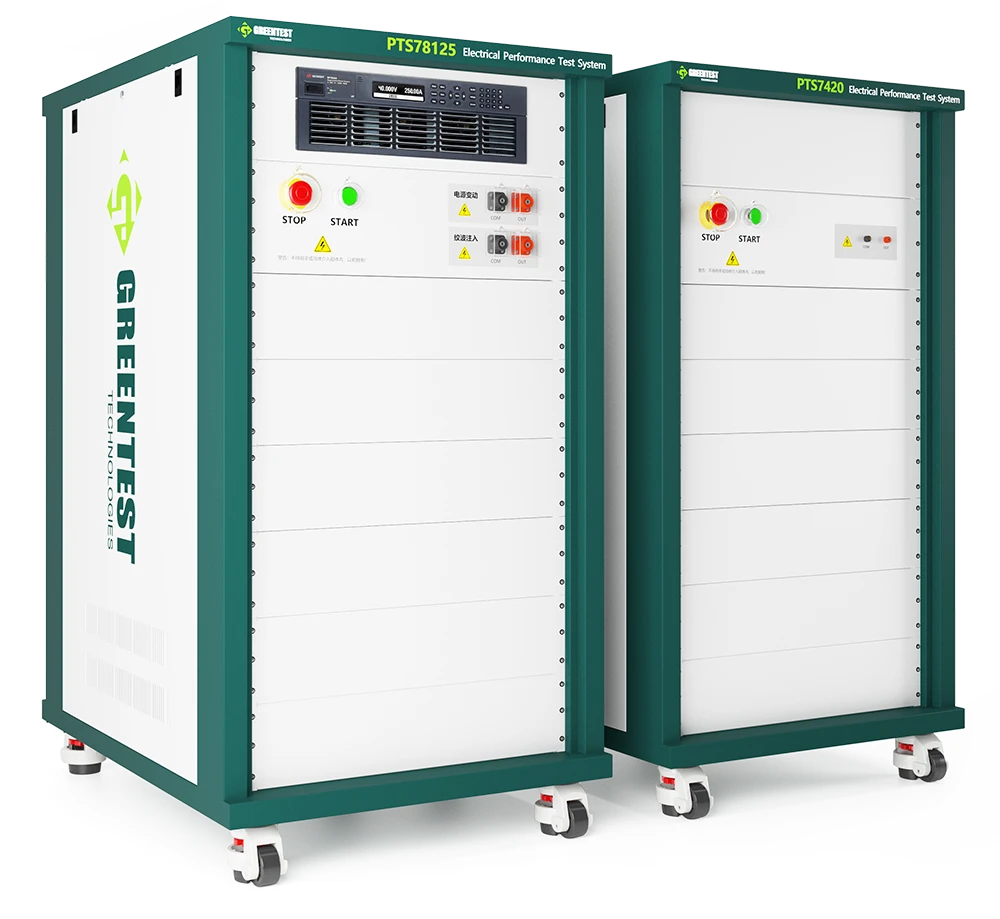
GreenTest Technology's PTS series electrical performance test system consists of the PTS series power system, load dump module (optional), micro-interrupt module (optional), and other equipment. It is a modular, high-precision professional test platform specifically designed for electrical performance testing of automotive components.

High Integration Design High Integration Design
Integrated Software and Hardware Integrated Software and Hardware
Multi-Standard Compatibility Multi-Standard Compatibility
Easy to Expand Easy to Expand
Test System

PTS Series Power System

6. Test Software

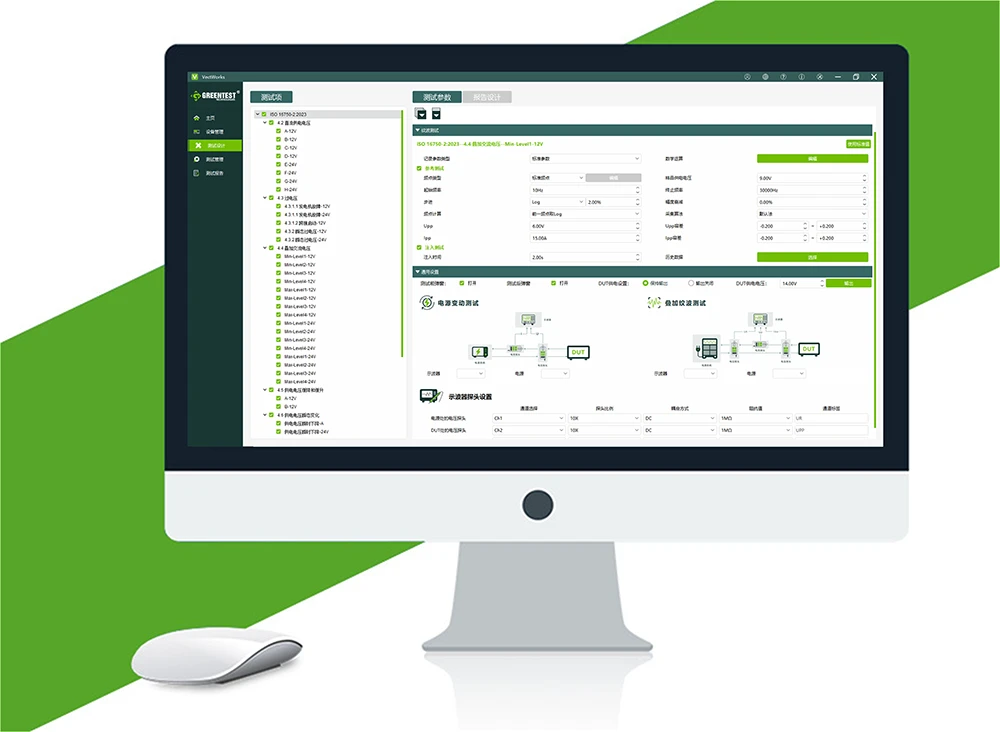
VectWorks electrical performance test software is a software developed by GreenTest Technology based on the GtestWorks automated test platform. Its engine is based on dynamic test script execution. This foundational architecture facilitates easy and direct configuration of test sequences without needing specific knowledge of remote instrument control. Simply configure the test items and levels required, offering high flexibility.

The software provides users with standard-compliant test templates, enabling remote parameter setting, data acquisition, waveform editing, configuration import/export, report viewing, etc., achieving automation of complex tests.

Core Functions

Closed-Loop Dynamic Testing

Closed-Loop Dynamic Testing

Integrated real-time monitoring and dynamic feedback mechanism

High/Low Voltage Superimposed Ripple Test

High/Low Voltage Superimposed Ripple Test

Complies with standard verification requirements (including ripple Upp, Ipp monitoring)

Power Supply and Amplifier Architecture

Power Supply and Amplifier Architecture

Compatible with bipolar power supply and amplifier architecture solutions

Test Software Interface

7. Conclusion

Vehicle ECU electrical performance testing is a strategic link to ensure vehicle safety, achieve regulatory compliance, and enhance market competitiveness. Its core value is reflected in three dimensions:

Regulatory Compliance

Builds the foundation for global market access

Fault Prevention

Reduces brand risk and recall costs

R&D Optimization

Enhances R&D efficiency and competitiveness

Explore Sales, Technical & Solution Resources?

Contact Us
Tel: 020-2204 2442
E-mail:Sales@greentest.com.cn
微信客服二维码