Test Systems
GtestWorks Automated Testing Platform
VectWorks 3.0 Electrical Performance Test Software






As the national recommended standard converted from ISO 21780:2020, GB/T 45120-2024 maintains high consistency with it in the main technical content. The differences between ISO 21780:2020 and GB/T 45120-2024 are shown in the attached table. This article will interpret based on GB/T 45120-2024 "Road vehicles — 48V supply voltage — Electrical requirements and tests".
With the increasing electrification of automobiles, the traditional 12V power supply system can no longer meet the needs of high-power equipment such as intelligent driving and by-wire chassis. As a transitional solution, the 48V low-voltage system can increase the power transmission capability by 4 times without significantly increasing costs, effectively solving the power bottleneck problem of the 12V system. In this context, GB/T 45120-2024 was developed to unify the technical requirements of the 48V system, standardize test methods, and promote the standardized development of the industry.
The implementation of this standard will reshape the automotive industry chain landscape:
Need to upgrade electrical architecture design to adapt to the 48V system
Promote technological innovation in core components such as DC/DC converters and high-power motors
Generate new testing demands, such as building voltage ripple testing capabilities
| Voltage Range | Range | Typical Scenario | Allowed Duration |
|---|---|---|---|
| Nominal Voltage | 36V≤U≤52V | Normal Operation | Continuous |
| High Temporary Voltage Range | 52V<U≤54V | Calibrating storage media, Energy recovery | Short-term |
| Overvoltage Range | 54V<U≤58V | Energy feedback, Control error | Short-term |
| High Overvoltage Range | 58V<U≤60V | Control error | |
| Low Temporary Voltage Range | 31V≤U<36V | Boost, Cold start | Short-term |
| Undervoltage Range | 24V≤U<31V | Cold start | Short-term |
| Low Undervoltage Range | 0V≤U<24V | Short-term discontinuous power supply, Long-term parking |
The standard divides component functional states into 5 levels, with core requirements as follows:
The component meets functional requirements, performance without deviation, no performance degradation or shutdown
The component meets functional requirements, allows performance outside tolerance, shutdown is not permitted
The component cannot meet functional requirements, allows performance degradation or shutdown. If necessary operating conditions are met, the function automatically recovers and performance returns to the specified level
The component cannot meet functional requirements, allows performance degradation or shutdown. After the vehicle operating state changes and necessary operating conditions are met, the function automatically recovers and performance returns to the specified level
Component function fails, but no spontaneous combustion occurs. After the test, the component needs repair or replacement to continue use
| Test Item | DC | Edge Characteristics | Remarks |
|---|---|---|---|
| Test-01: Nominal Voltage Range | 36-52V | 0.16V/ms | The DUT must be continuously monitored until the test cycle ends; |
| Test-02: Low Temporary Voltage Range and High Temporary Voltage Range | 31-36V | 0.5V/ms | Low temporary voltage and high temporary voltage tests are cycled 5 times each; |
| Test-03: Instantaneous Overvoltage | 52-70V | 25.71V/ms |
1. 70V must last for 40ms; 2. Test cycle count 1000 times; |
| Test-04: Power Supply Component Load Dump Control | 52-70V | 25.71V/ms | 1. R=36Ω; 2. C=0.5mF; 3. Requires 100μs switch; 4. The actual switching time should be measured during or before/after the test; |
| Test-05: Starting Characteristics | 24-36V | 2.4V/ms | The DUT must be continuously monitored until the test cycle ends; |
| Test-06: Long-term Overvoltage | 52-60V | 80V/s | The DUT must be continuously monitored until the test cycle ends; |
| Test-07: Overvoltage for Energy-Consuming Components Capable of Supplying Power | 52-58V | 25V/ms | The maximum voltage level of the DUT should not exceed U1, and the time from the voltage exceeding U2 to falling below U2 should not exceed t1 in Figure 12; |
| Test-08: Supply Voltage Reduction and Increase | 0-44V | 35mV/s | The DUT must be continuously monitored until the test cycle ends; |
| Test-09: Voltage Ripple | 31-54V |
/ | 1. Test combination: Verification required at different voltage points f1: U0=35V and 50V; f2: U0=34V and 51V; f3: U0=32V and 53V; 2. Frequency and Limits: f1: 10Hz~1kHz, 8Vpp/80App; f2: 1kHz~30kHz, 6Vpp/15App; f3: 30kHz~200kHz, 2Vpp/10App; 3. The test is divided into reference test and voltage ripple test; |
| Test-10: Reset Characteristics | 0-36V | ΔU1=2V ΔU2=0.5V |
The function reaches FS1 at voltage U0. Below U0, the function should comply with Table 2 requirements. If the DUT enters FS4, it should be restarted before the next voltage dip; |
| Test-11: Short-term Power Interruption | 48V | / | 1. R1≤60mΩ; 2. Switch response time ≤10μs; 3. Two reference measurements are required before the formal test; |
| Test-12: Ground Failure | / | / | 1. Triple switch verification for ground failure; 2. Three-part test required: Part 1: Reference test; Part 2: GND48 ground failure test; Part 3: GND12/24 ground failure test; |
| Test-13: Fault Current | / | / | 1. Test Option 1: The total current flowing between the 12V/24V and 48V short-circuit connection points (communication and I/O) should satisfy | I |≤10μA; 2. Test Option 2: The current flowing between each 12V/24V connection point (communication and I/O) and the 48V short-circuit connection point (communication and I/O) should satisfy | I |≤10μA; |
| Test-14: Ground Offset | 36V,52V | / | 1. Test setup divided into Option 1 and Option 2; 2. ±1V potential difference must not affect the DUT functional state; |
| Test-15: Signal Line and Load Circuit Short Circuit | 36V,52V | / | 1. Zi1, Zi2≤0.02Ω; 2. Tests required for four conditions: U0=36V, Operating Mode 2.3; U0=52V, Operating Mode 2.3; U0=36V, Operating Mode 2.4; U0=52V, Operating Mode 2.4; |
| Test-16: Quiescent Current | 48V | / |
1. DUTs are classified based on whether they have periodic wake-up function, and the test time t1 differs for both; 2. During the test, the DUT must remain in sleep state, current is measured at 1Hz frequency for no less than 12h; |
| Standard Number | GB/T 45120-2024 | ISO 21780:2020 |
|---|---|---|
| Test Item | Test-14: Ground Offset | Test-14: ground offset |
| Test Duration | Not specified | t1=1min |
| Test Item | Test-16: Quiescent Current | Test-16: quiescent current |
| Measurement Time | 12h plus the duration after the last wake-up cycle ends (for DUTs with periodic wake-up function) |
≥12h (for DUTs without periodic wake-up function) 12h plus the duration after the last wake-up cycle ends (for DUTs with periodic wake-up function) |
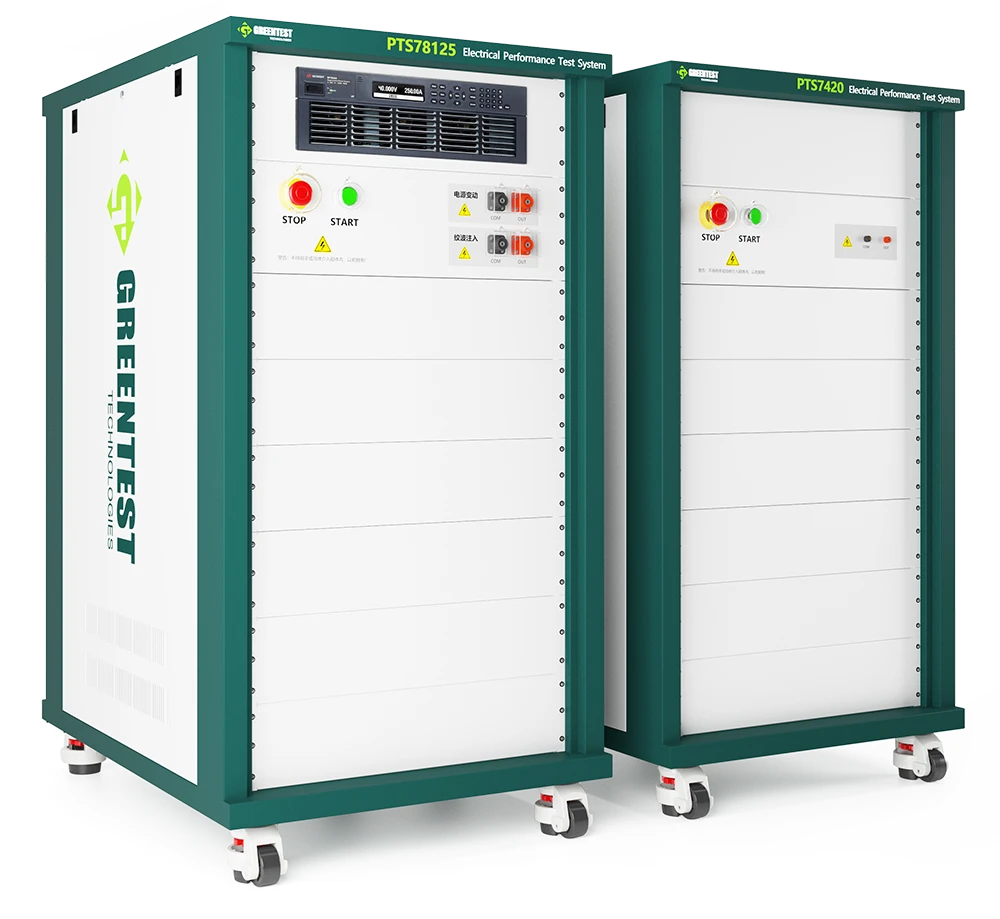
GreenTest Technology's PTS series electrical performance test system consists of the PTS series power system, load dump module (optional), micro-interruption module (optional), and other equipment. It is a modular, high-precision professional test platform specifically designed for electrical performance testing of automotive components.

High Integration Design

Integrated Software and Hardware

Multi-Standard Compatibility

Easy to Expand
PTS Series Power System
VectWorks Electrical Performance Test Software is a software developed by GreenTest Technology based on the GtestWorks automated test platform. Its engine is based on dynamic test script execution. This infrastructure facilitates easy and direct configuration of test sequences without requiring specific knowledge of how to remotely control instruments. Users only need to configure the test items and test levels, offering high flexibility.
The software provides users with standard-compliant test templates, enabling remote parameter setting, data acquisition, waveform editing, configuration import/export, report viewing, etc., achieving automation of complex tests.

Closed-Loop Dynamic Testing
Integrates real-time monitoring and dynamic feedback mechanisms

High/Low Voltage Superimposed Ripple Test
Complies with standard verification requirements (including ripple Upp, Ipp monitoring)

Power Supply and Amplifier Architecture
Compatible with bipolar power supply and amplifier architecture solutions