logo

Introduction

Vehicle PDU Product Overview

Vehicle PDU (Power Distribution Unit, High Voltage Distribution Box), as the "nerve center" of the electric vehicle high-voltage system, is the core energy distribution component connecting the battery pack with various high-voltage electrical appliances. It achieves high-voltage electrical energy transmission and distribution through key components such as contactors and copper busbars. Its industrial importance has significantly increased with the expansion of the new energy vehicle market, becoming an indispensable key part of the high-voltage system.

Core Significance of Electrical Performance Testing

The core significance of electrical performance testing can be systematically explained through a "risk-cost-compliance" three-dimensional analysis framework, demonstrating its irreplaceable value in reducing potential risks, optimizing cost structures, and ensuring compliance access.

Risk Control
Quantitatively evaluate key indicators, enhance the safety redundancy of the entire vehicle's electrical system, and effectively avoid risks such as equipment damage caused by performance non-compliance.
Cost Optimization
Establish standardized verification processes, standardize technical indicators and acceptance requirements, reducing repetitive development and adaptation costs caused by inconsistent standards.
Compliance Access
Electrical performance testing is a necessary step to ensure products comply with industry technical specifications and regulatory requirements.

Through the synergistic effect of the three-dimensional value of "risk-cost-compliance", electrical performance testing is not only a technical means to ensure the safe and reliable operation of vehicle PDUs, but also a key link in reducing the full life cycle cost and ensuring market access. Its irreplaceability is particularly prominent in the process of industry standardization and technological upgrades.

Test Items

ISO 21498-2:2024

ISO 21498-2:2024 is an international standard for electrical performance testing of high-voltage components in new energy vehicles, applicable to high-voltage component testing for DC 60V-1500V.

Test Category Test Item Remarks
Power Variation 6.2 DC supply voltage variation within operational range ≤2V/s
Emission 6.3 Generated voltage slope  
Power Variation 6.4 Immunity to voltage slope ≥1/10/20V/ms
Emission 6.5 Generated voltage ripple  
Ripple Immunity 6.6 Immunity to voltage ripple f:100Hz-150kHz
Power Variation 6.7 Overvoltage ≤2V/s
Power Variation 6.8 Undervoltage ≤2V/s
Power Variation 6.9 Voltage offset ≤2V/s
Emission 6.10 Generated load dump voltage  
Power Variation 6.11 Immunity to load dump voltage ≥250V/ms
Power Variation 6.12 Short circuit  

VW80300:2021

VW80300 2021 is a test standard of the Volkswagen Group, which supplements VW80000 and specifies various requirements, test conditions, and test methods for electrical, electronic, and electromechanical components and systems of motor vehicles.

Test Category Test Item Remarks
Voltage Variation 6.2 EHV-01 Performance test within the regular HV operating voltage range (Vopmax,HV-VN,HV)/5min
(Vopmax,HV-Vop,unlim,max,HV)/5s
Voltage Variation 6.3 EHV-02 Operation within the HV overvoltage range (Vmax,HV-VN,HV)/1min
Voltage Variation 6.4 EHV-03 Operation within the HV undervoltage range VN,HV/1min
Function Test 6.5 EHV-04 Pre-charging  
Emission Test 6.6 EHV-05 Generated HV voltage dynamics  
Voltage Variation 6.7 EHV-06 System HV voltage dynamics 450V electrical system:20V/ms
900V electrical system:40V/ms
Battery Test 6.8 EHV-07 HV voltage dynamics of energy storage devices Source:-150A/ms
Load:+150A/ms
Emission 6.9 EHV-08 Generated HV voltage ripple  
Voltage Ripple 6.10 EHV-09 System HV voltage ripple case 1:Vopmin,HV,VN,HV, Vopmax,HV
case 2:VN,HV
Pulse Immunity 6.11 EHV-10 System load dump – 6.11.2 Load dump up to HV voltage before failure 250V/ms
Pulse Immunity 6.11 EHV-10 System load dump – 6.11.3 System load dump with high rate of change 3000V/ms
Voltage Variation 6.12 EHV-11 HV voltage offset test step 2:1ms…1/4T时间内上升或下降1/6VHV
Current Variation 6.13 EHV-12 HV overcurrent 20s内从0上升至Iopmax,HV
Life Cycle Test 6.14 EHV-13 HV service life(additional)  
Life Cycle Test 6.15 EHV-14 On/off durability testing for HV components  
Function Test 6.16 EHV-15 Functionality of HV interlock , maintenance connector , and crash signaling  
Pulse 6.17 EHV-16 HV pulse 1V/ns
Emission 6.18 EHV-17 Voltage limiting for load dump 电流在≤5ms内从Iopmax下降到0.1*Iopmax

Temperature Rise Test

The temperature rise test is a core method to ensure the thermal stability of vehicle PDUs under high voltage and high current conditions. Its necessity is first reflected in the increased temperature rise risk brought about by the development of high-voltage platform technology. With the promotion of 800V and other high-voltage platforms, the current-carrying density has significantly increased, leading to increased heating risks in key components such as copper busbars and connectors inside the PDU. If temperature rise is out of control, it may cause insulation aging, component performance degradation, and even circuit failure.

The connection process significantly affects temperature rise, and the difference in contact resistance of different processes directly affects the degree of heating. For example, the contact resistance of laser welding process can be as low as 0.8mΩ, while the contact resistance of traditional bolt fastening process is about 1.2mΩ. According to Joule's law, under the same current load, the laser welding connection point with smaller contact resistance has lower heat generation and better temperature rise control. Conversely, the bolt fastening process may cause increased local temperature rise risk due to higher contact resistance.

Test System

Standard Support

  • ISO 16750-2:2023
  • VW 80000:2021
  • MBN LV124-1 2013
  • ISO 21780:2020
  • GB/T 45120-2024
  • MBN LV148 2013
  • ISO 21498-2:2024
  • VW 80300:2021
  • ......

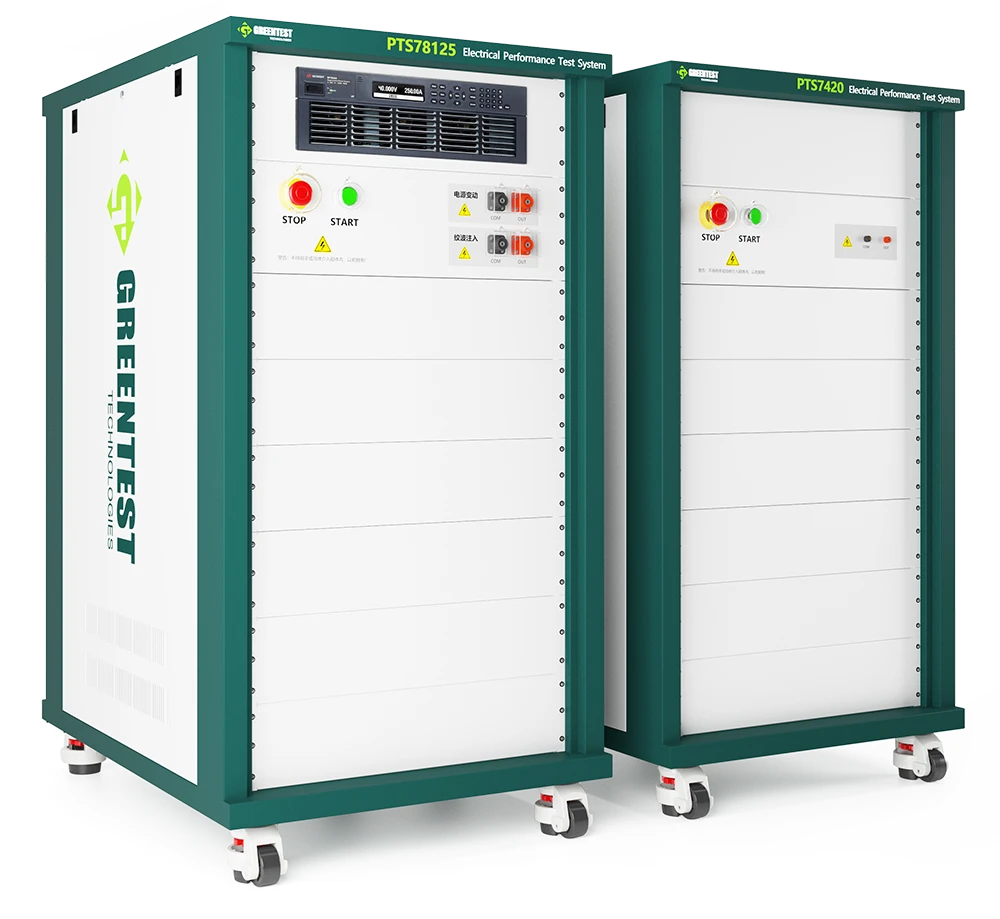
GreenTest Technology's PTS series electrical performance test system consists of the PTS series power system, load dump module (optional), micro-interruption module (optional) and other equipment. It is a modular, high-precision professional test platform specifically designed for electrical performance testing of automotive components.

High Integration Design

High Integration Design

Hardware and Software Integration

Hardware and Software Integration

Multi-Standard Compatibility

Multi-Standard Compatibility

Easy to Expand

Easy to Expand

Test System

PTS Series Power System

Test Software

VectWorks electrical performance test software is a software developed by GreenTest Technology based on the GtestWorks automated test platform. Its engine is based on dynamic test script execution. This infrastructure facilitates easy and direct configuration of test sequences without requiring specific knowledge of how to remotely control instruments. Users only need to configure the test items and test levels, offering high flexibility.

The software provides users with standard-compliant test templates, enabling remote parameter setting, data acquisition, waveform editing, configuration import/export, report viewing, etc., achieving automation of complex tests.

Core Functions

  • Closed-Loop Dynamic Testing

    Closed-Loop Dynamic Testing

    Integrated real-time monitoring and dynamic feedback mechanism

  • High and Low Voltage Superimposed Ripple Test

    High and Low Voltage Superimposed Ripple Test

    Complies with standard verification requirements (including Upp, Ipp ripple monitoring)

  • Power Supply and Amplifier Architecture

    Power Supply and Amplifier Architecture

    Compatible with bipolar power supply and amplifier architecture solutions

Test Software Interface

Conclusion

Test Necessity Summary

Vehicle PDU electrical performance testing is a core link in building a positive cycle model of "testing investment-product competitiveness-market share". Its necessity is reflected in multiple dimensions of technical assurance, standard compliance, and industry development. From the product level, the stability, safety, and energy efficiency of the PDU directly determine the reliable operation of the entire vehicle system. Comprehensive electrical performance testing is a necessary means to ensure these core indicators meet standards and avoid potential risks, laying the foundation for product competitiveness.

Testing Investment-Product Competitiveness-Market Share Positive Cycle

In a market environment where the penetration rate of new energy vehicles has exceeded 30%, electrical performance testing has gone beyond the scope of basic quality assurance and has become a key indicator to measure the core competitiveness of enterprises. Its investment intensity directly affects the performance of enterprises in terms of technical barriers (such as patent numbers), market response speed, and brand premium capability. Ultimately, through the positive cycle of "testing investment enhances product competitiveness, competitiveness expands market share, and market share feeds back testing investment", it drives continuous technological innovation and high-quality industry development for enterprises.

Explore Sales, Technical & Solution Resources?

Contact Us
Tel: 020-2204 2442
E-mail:Sales@greentest.com.cn
微信客服二维码